
Next-Generation Intra-Articular Injections: When Hyaluronic Acid No Longer Travels Alone
Osteoarthritis is usually pictured as a story of cartilage and bone. But the first change — and the one that drives most of the pain — happens in something almost invisible: the synovial fluid.
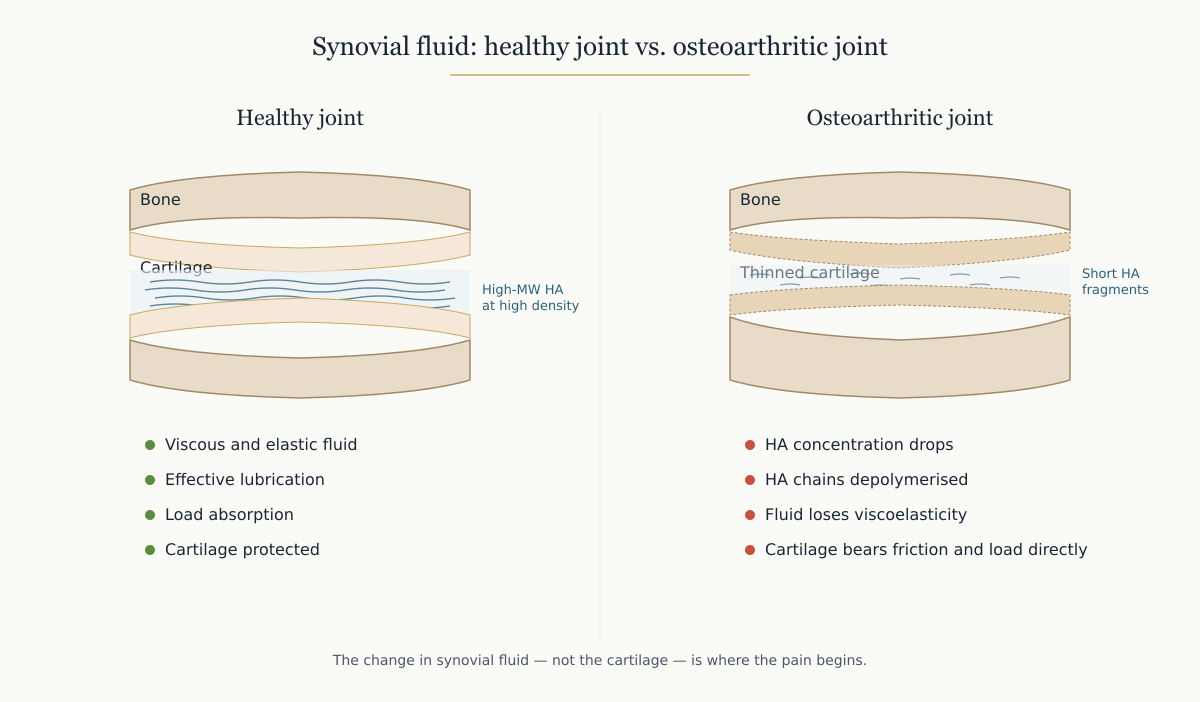
What synovial fluid does in a healthy joint
Inside a joint, the two cartilage surfaces do not rub against each other directly. Between them sits a thick, clear fluid that is at once viscous and elastic — viscous enough to lubricate the joint as it moves, and elastic enough to absorb load when it bears weight. The component that produces both properties is hyaluronic acid (HA), a long-chain polysaccharide.
In chronic and degenerative joint diseases, endogenous HA declines in two ways at once: its concentration drops and it becomes depolymerised — the long chains are cut into shorter fragments. The synovial fluid loses its viscoelasticity. The joint loses its biological cushion, and the pain begins.
This is the basis for a class of medical products that has been in use for more than three decades: intra-articular viscosupplementation. In regulatory terms, these products are not drugs but medical devices — specifically synovial fluid substitutes, injected directly into the joint cavity.
Two mechanisms: mechanical replacement and biological stimulation
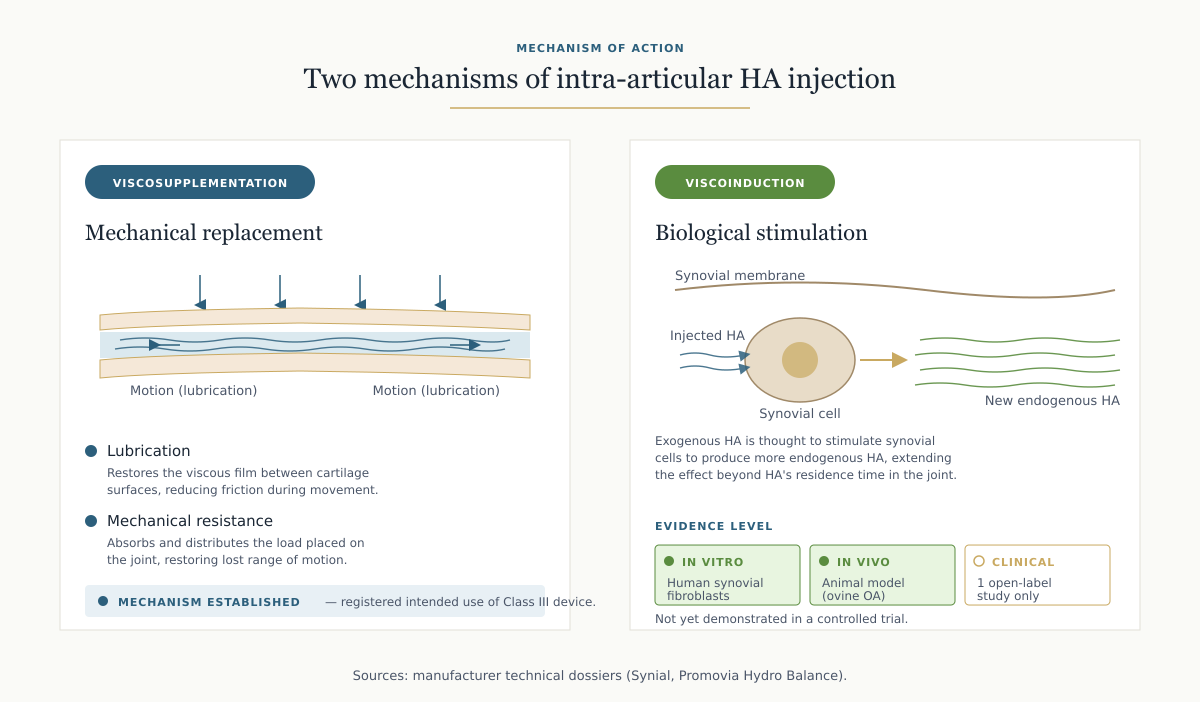
Technical documentation from European manufacturers typically describes two mechanisms working in parallel.
Viscosupplementation is the mechanical mechanism, and the one best understood. HA gel introduced into the joint restores the viscous film between the two cartilage surfaces and does two things: it lubricates the surfaces to reduce friction during movement, and it provides mechanical resistance to absorb and distribute the load placed on the joint. This is the intended use recorded in the regulatory documentation for this class of products.
Viscoinduction is the biological mechanism: exogenous HA stimulates synovial cells to produce more endogenous HA, so the effect persists after the injected HA itself has been metabolised. This mechanism explains a clinical observation that is hard to reconcile with pure mechanics: pain relief lasts for months, while the residence time of HA in the joint is measured in days to a few weeks.
The evidence for this needs to be described precisely. This is a mechanism with consistent preclinical support and supportive early clinical data — not merely in vitro data, but also not yet at the level of a proven claim that injected HA "stimulates endogenous HA synthesis". The evidence sits at three tiers:
- In human cells (in vitro). The foundational study by Smith and Ghosh (1987) on human synovial fibroblasts showed that exogenous HA modulates the cells' rate of HA synthesis, and that cells taken from osteoarthritic joints respond most strongly. Importantly: the effect depends on molecular weight — see below.
- In animals (in vivo). In an ovine model of osteoarthritis, injecting 500–730 kDa HA increased endogenous HA in the synovial fluid by roughly 70%, a statistically significant change. For much larger HA (2300 kDa) the increase was small and not significant — interpreted as the molecule being too large to reach synovial cells effectively.
- In humans. A study by Bagga and colleagues (2006) aspirated synovial fluid from patients with knee osteoarthritis before injection and at three and six months. At three months, HA concentration in the synovial fluid was up 13% and viscoelasticity up 16%, both statistically significant. At six months, the 10% increase did not reach significance. This was an open-label study without a control group, with progressively fewer patients followed up, and the assay could not distinguish injected HA from endogenous HA.
Put differently: the hypothesis has support at all three tiers of evidence and is considered one of the more notable biological effects of viscosupplementation in the current literature — but it has not yet been demonstrated in a controlled clinical trial.
The real limitation of HA alone: hyaluronidase
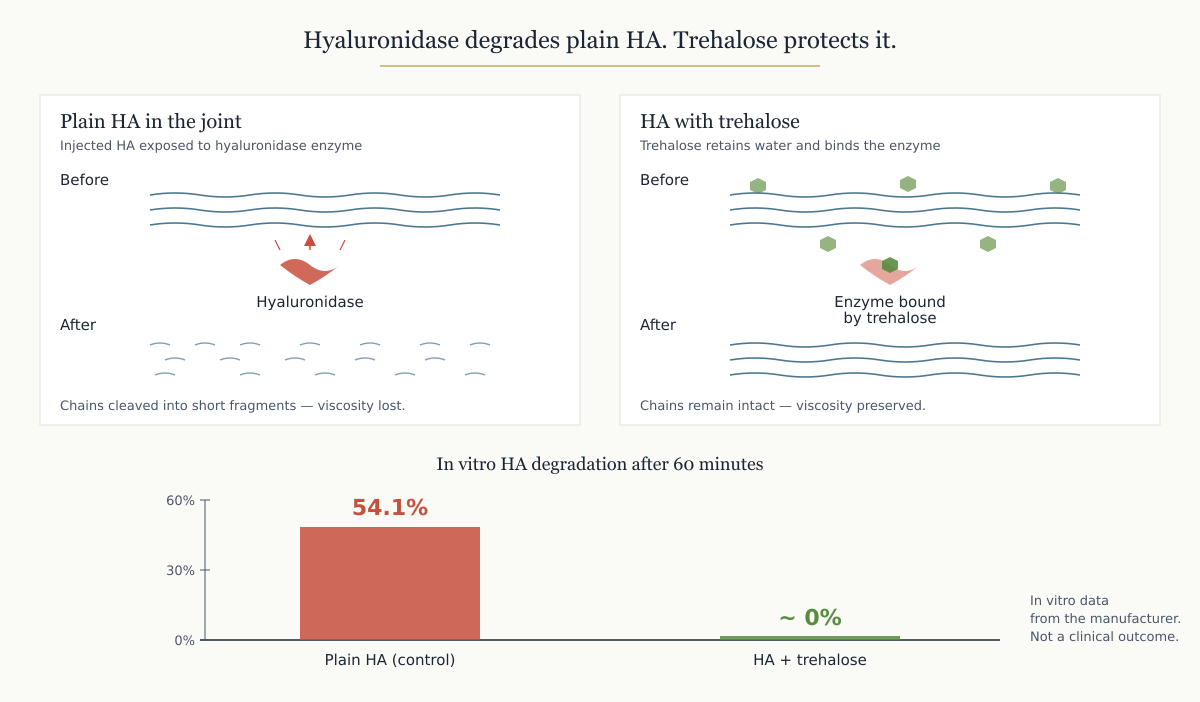
If injecting HA into the joint were the end of the story, the story would have ended long ago. The problem is that the joint is not a neutral environment. It contains hyaluronidase — the enzyme that cleaves HA chains — and its activity rises under inflammatory conditions. Injected HA is hydrolysed relatively quickly; the viscosity that was just restored declines again.
This is the technical reason behind a trend in European formulations over recent years: no longer using HA alone, but combining HA with a partner ingredient to protect it or extend its action.
How an intra-articular injection is performed
This entire class of products is administered only by physicians, under aseptic technique. The general procedure per the manufacturer's instructions for use has four steps.
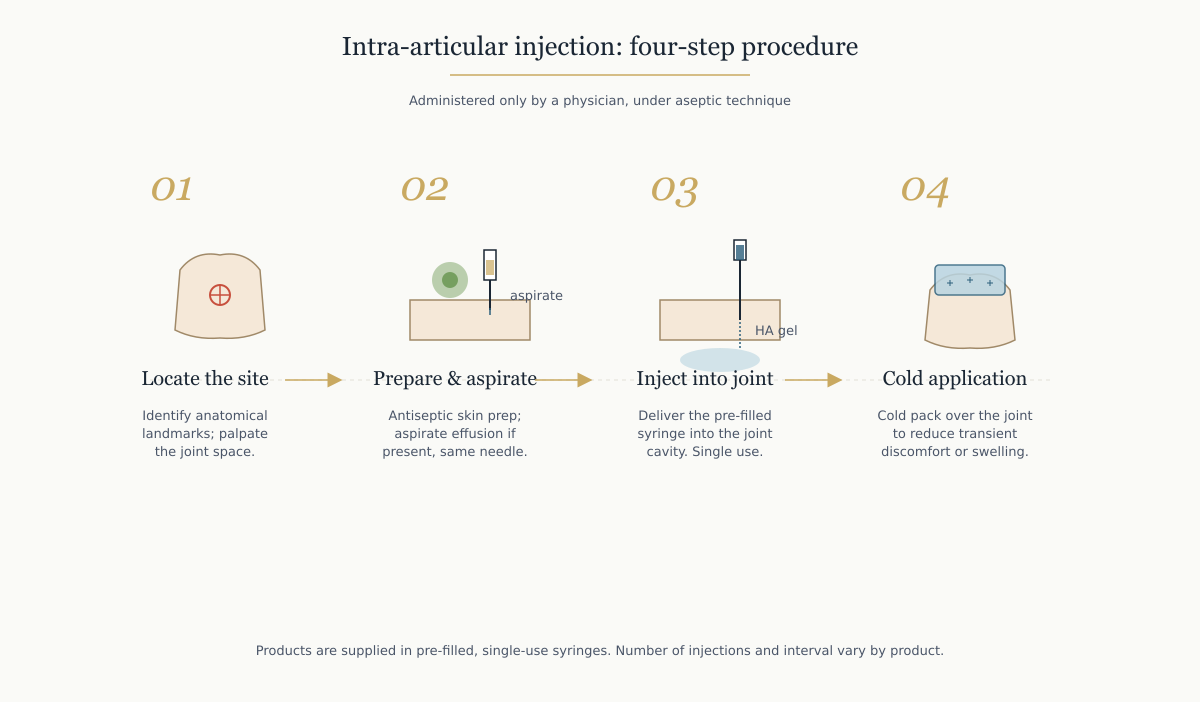
The number of injections and the interval between them varies between products, depending on HA concentration, syringe volume, and formulation. This is one of the most practical points of differentiation across product lines — and the one clinicians tend to focus on first.
Three intra-articular injection lines in LKD Health's portfolio
LKD Health currently works with three Italian manufacturers in this category. All three are Class III medical devices, but they are positioned quite differently.
- Hydro Balance — medium-chain HA combined with short-chain HA and trehalose as a technological excipient. The formulation is protected by patent no. 102018000010415. Available in 50 mg/2 ml and 100 mg/4 ml presentations. This line represents the "protect HA from enzymatic degradation" approach.
- Praokin — 48 mg of HA combined with 150 mg of MSM in a 3 ml pre-filled syringe. This line represents the "add a biologically active partner ingredient" approach.
- Syndial — sodium hyaluronate produced by biological fermentation from Streptococcus equi, without chemical processing, available in five different concentrations so that the clinician can choose according to the severity of the lesion and the size of the joint. This is the plain HA line, flexible on concentration.
These three positions do not compete directly with one another. For a distributor or a musculoskeletal department, they cover three price points and three different clinical situations.
Important note
This article provides technical information on a class of medical devices, intended for distribution partners and healthcare professionals. The content is not intended to diagnose, treat, or replace medical advice. The use of intra-articular injection products must be prescribed and administered by a physician.
Interested in this product category?
LKD Health provides technical dossiers, CE certificates, training materials and pricing for distribution partners, pharmacy chains, clinics and hospitals. Every manufacturer in our portfolio has been directly audited by the LKD team before any partnership is signed.
Contact LKD Health